About today's jump

EXIT & FREEFALL
PRECISION LANDING
EXIT & FREEFALL
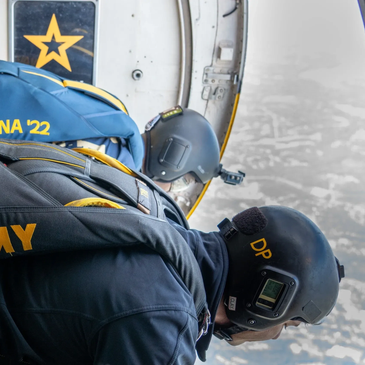
For today's demonstration, jumpers exit the aircraft from approximately 4,500 feet above ground level. After exit, they accelerate to around 120 mph in freefall while maintaining controlled body position.
TIMING
PRECISION LANDING
EXIT & FREEFALL
Although the jump may appear seamless, each phase is carefully planned and timed. Jumpers exit in sequence, manage their fall rate in freefall, and adjust their canopy flight to maintain spacing.
.webp/:/cr=t:0%25,l:16.66%25,w:66.68%25,h:100%25/rs=w:365,h:365,cg:true)
VISUAL ELEMENTS
PRECISION LANDING
PRECISION LANDING
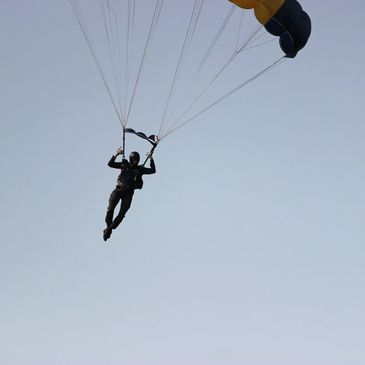
After deployment, jumpers fly high-performance parachutes toward the landing area. During this phase, you may see elements such as flag displays, smoke, or canopy formations, where parachutes fly in a formation.
PRECISION LANDING
PRECISION LANDING
PRECISION LANDING
Each jumper aims to land within a designated target area, requiring precise timing and control during the final approach. Today's demonstration highlights the team's focus on accuracy, consistency, and safety.
Gear Used Today

CANOPIES
PARACHUTE SYSTEM
CANOPIES
Jumpers use high-performance ram-air parachutes designed for precision control and accurate landings. These canopies allow for responsive handling and controlled approaches in tight landing areas.
FLAGS
PARACHUTE SYSTEM
CANOPIES
Large flags may be carried during the jump, including the American, Beat Army, and USNA class flags. These are securely attached to the jumper and deployed after canopy opening for visibility and presentation.
SMOKE
PARACHUTE SYSTEM
PARACHUTE SYSTEM
Colored smoke is generated using a small device attached to the jumper's foot. It is used to enhance visibility in the sky and create a more dynamic visual experience for spectators.
PARACHUTE SYSTEM
PARACHUTE SYSTEM
PARACHUTE SYSTEM
Each jumper wears a complete parachute system consisting of a main canopy, a reserve canopy, and an automatic activation device, all designed to ensure safety and reliability throughout the jump.